
Mechanical Engineering Question Bank
Combined Two Banks (Sonali Bank PLC & Rajshahi Krishi Unnayan Bank-RAKUB)- 2026
Post: Assistant Engineer (Mechanical)
Exam Date: 10.01.2026
Time: 2 Hours
All Departmental (14 Written Questions + 30 Objective Questions)
Departmental (Written):
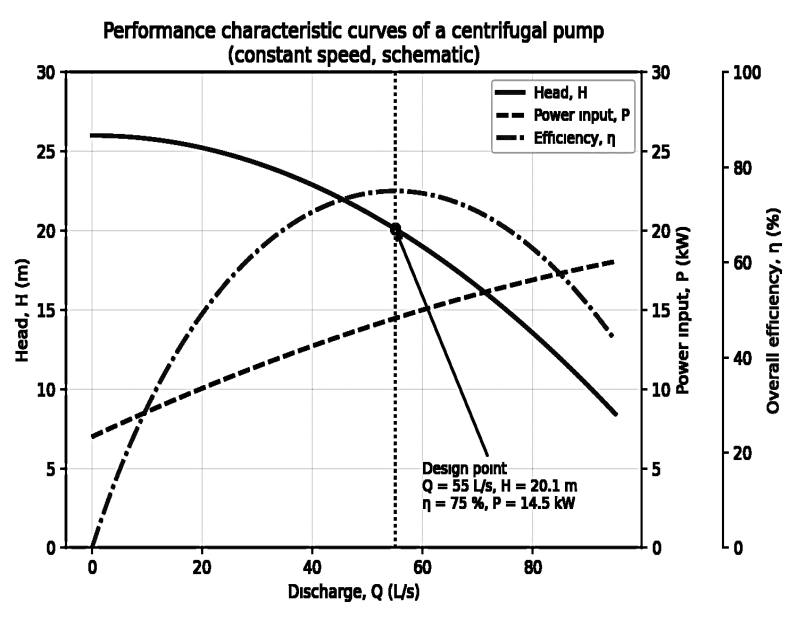
1) Sketch the performance characteristic curves of a centrifugal pump. A centrifugal pump delivers 0.055 m³/s of water to a height of 16 m through a pipe 150 mm in diameter and 25 m long. If the overall efficiency is 75% and f = 0.05 for the pipe, find the power required to drive the pump.
Solution: Given, Q = 0.055 m³/s, Hs = 16 m, D = 0.15 m, L = 25 m, ηo = 0.75, f = 0.05 (Darcy).
The velocity head at the pipe outlet, V²/2g = 0.49 m
(Answer)
Performance characteristic curves (at constant speed): head H, power P and efficiency η plotted against discharge Q.
2) The air conditioning system of a building developed a fault and the building was not being cooled evenly. What could be the reasons and how would you solve the problem?
Solution: Reasons for uneven cooling:
- Unbalanced air distribution — wrongly set dampers or badly sized ducts
- Leaking, crushed or blocked ducts and closed vents
- Dirty filters, coils or blower, reducing airflow and capacity
- Low refrigerant charge or a weak compressor
- Thermostat located in a wrong place (in sunlight or near a supply diffuser)
- Unequal heat loads — sun-facing or crowded rooms, poor insulation
- Inadequate return air path
Remedies:
- Measure room temperatures and airflow at each diffuser and compare with design values
- Clean or replace filters; clean coils, fan and drain lines
- Check refrigerant charge, compressor, fan motors and controls
- Seal and repair ducts; remove obstructions; insulate ducts
- Carry out air balancing by adjusting dampers and diffusers
- Relocate the thermostat; provide zoning (VAV boxes), extra return grilles or supplementary units for high-load rooms
3) For a particular application, two gear options are considered: Option 1 — helical gear; Option 2 — planetary gear. Compare them and state which is more suitable.
Solution:
| S.No. | Helical Gear Drive | Planetary Gear Drive |
|---|---|---|
| 1. | The input and output shafts are parallel (offset). | The input and output shafts are coaxial. |
| 2. | Its torque density is moderate. | Its torque density is very high, as the load is shared by several planet gears. |
| 3. | It is larger for the same torque. | It is compact and light for the same torque. |
| 4. | It runs very smoothly and quietly. | It produces slightly more noise. |
| 5. | Its cost is lower and its maintenance is simple. | Its cost is higher and its maintenance is more complex. |
| 6. | It is used in conveyors, pumps, compressors and general gearboxes. | It is used in automatic transmissions, wind turbines, robotics and heavy compact drives. |
The helical gear drive is preferred where low cost, quiet running and easy maintenance are required with parallel shafts. The planetary gear drive is preferred where high torque in a small space with coaxial shafts is required.
4) Explain the concepts and methods of TQM, Kaizen and JIT.
Solution: Total Quality Management (TQM): An organisation-wide approach in which every employee continuously improves the quality of products, services and processes to achieve customer satisfaction. Principles: customer focus, total employee involvement, process approach, continuous improvement and fact-based decisions. Tools: PDCA cycle, Pareto chart, cause-and-effect diagram, control charts and check sheets.
Kaizen: A Japanese term meaning “change for the better” — continuous small improvements by everyone, every day. Methods: 5S (sort, set in order, shine, standardise, sustain), PDCA, suggestion schemes, quality circles and elimination of waste (muda).
Just-in-Time (JIT): A production system (developed by Toyota) that produces and delivers only the required items, in the required quantity, at the required time. Features: pull system with kanban, small lots, quick set-up, reliable suppliers and zero defects. Benefit: minimum inventory and waste; limitation: a supplier delay can stop the line.
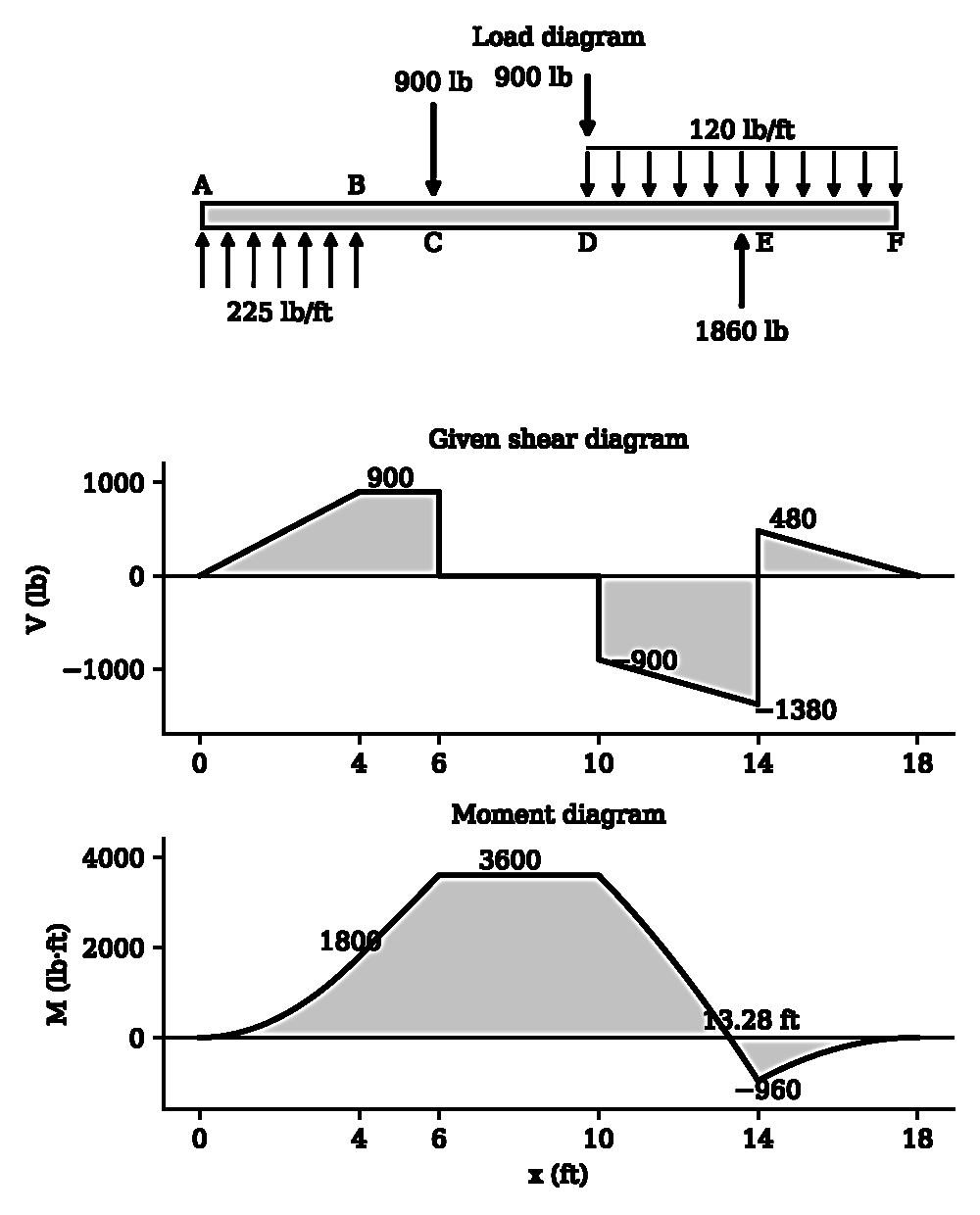
5) Draw the load and moment diagrams corresponding to the given shear diagram. Specify values at all changes of loading and at all points of zero shear.
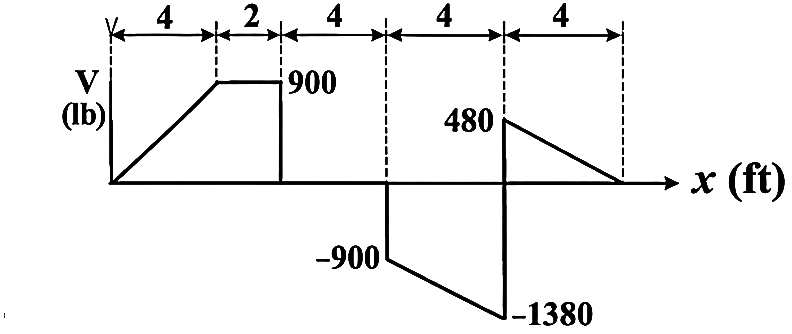
Solution: The slope of the shear diagram gives the load intensity and each jump gives a concentrated load:
- A–B (0–4 ft): shear rises from 0 to 900 lb → upward uniform load of 900/4 = 225 lb/ft
- B–C (4–6 ft): constant shear → no load
- At C (6 ft): drop of 900 lb → concentrated load of 900 lb downward
- C–D (6–10 ft): zero shear → no load
- At D (10 ft): drop of 900 lb → 900 lb downward
- D–E and E–F (10–18 ft): slope −480/4 = −120 lb/ft → downward uniform load of 120 lb/ft
- At E (14 ft): jump from −1380 to +480 lb → reaction of 1860 lb upward
Moments from the areas of the shear diagram: MB = ½ × 4 × 900 = 1800 lb·ft; MC = 1800 + 900 × 2 = 3600 lb·ft; MD = 3600 lb·ft; ME = 3600 − ½(900 + 1380) × 4 = −960 lb·ft; MF = −960 + ½ × 4 × 480 = 0. The moment is zero in DE at 3.28 ft from D (x = 13.28 ft).
6) A numerical problem on steam properties.
(Data could not be collected.)
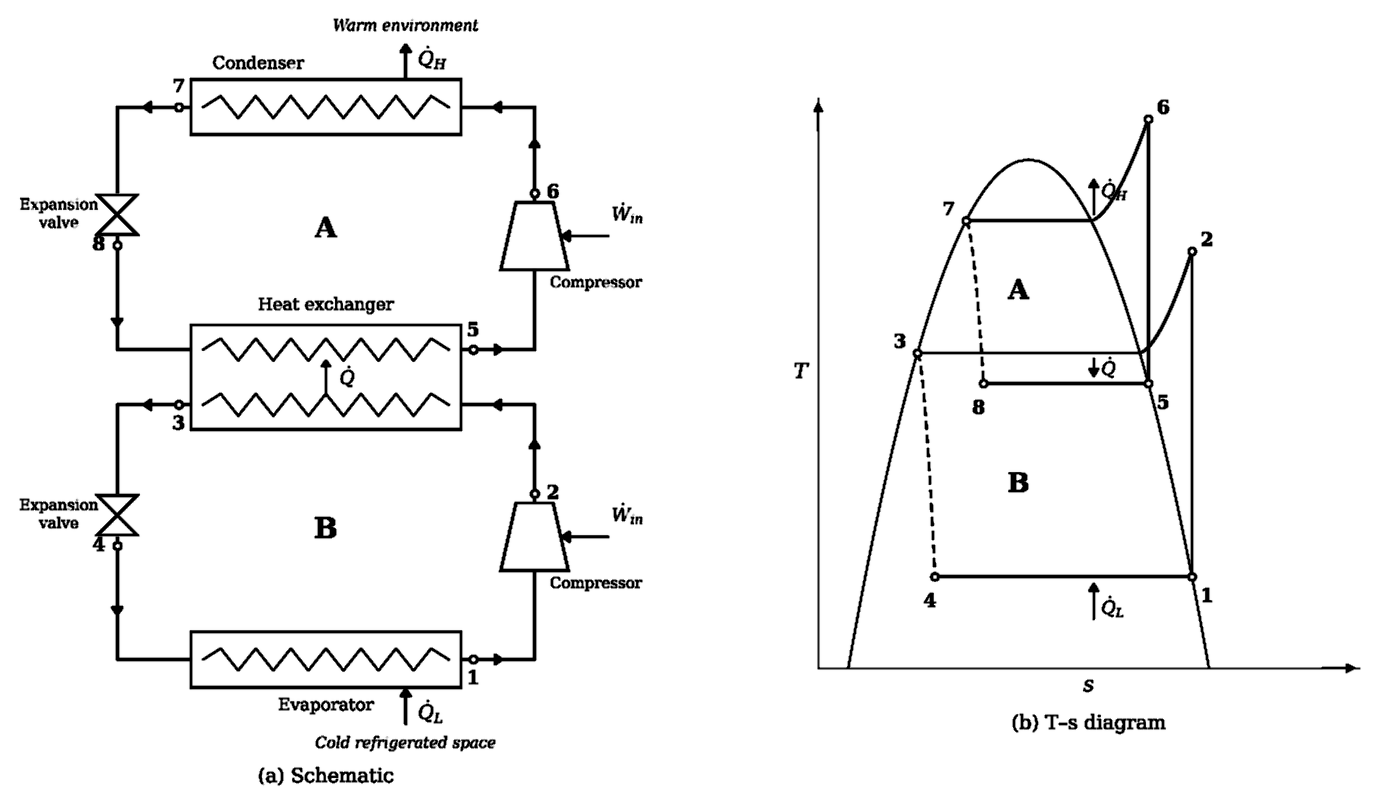
7) Draw the schematic and T–s diagram of a cascade refrigeration system.
Solution: [Repeated question: MPL-2025] In a cascade system, two (or more) vapour compression cycles are connected in series through a cascade heat exchanger, which acts as the condenser of the low-temperature (bottoming) cycle and the evaporator of the high-temperature (topping) cycle. It is used for very low temperatures, where a single cycle would have a large pressure ratio and poor COP.
8) Determine the COP for the given enthalpies.
(Data could not be collected; answer recalled: COP = 3.) [Similar: TGTDCL-2018]
Solution: For a vapour compression cycle (1: evaporator exit, 2: compressor exit, 3: condenser exit, 4 = 3 after throttling):
9) Determine the minimum height h of the beam shown if the flexural stress is not to exceed 20 MPa.
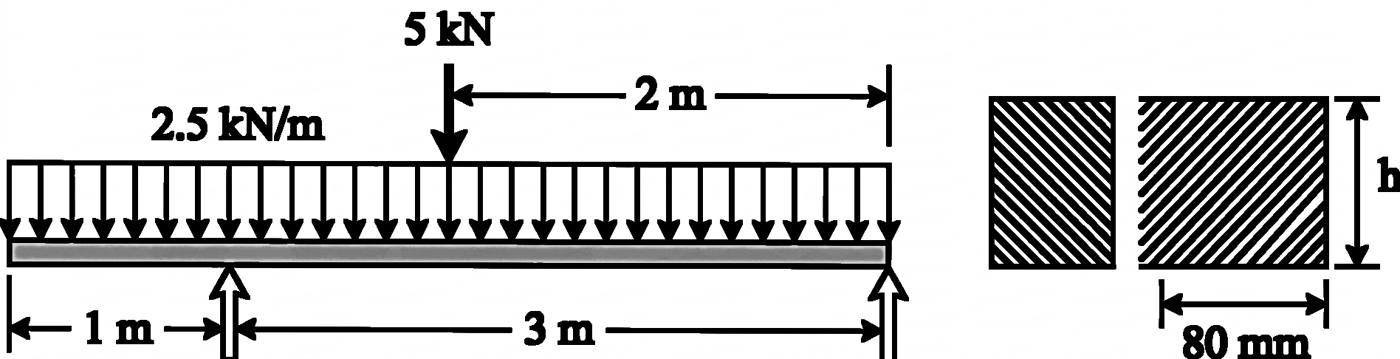
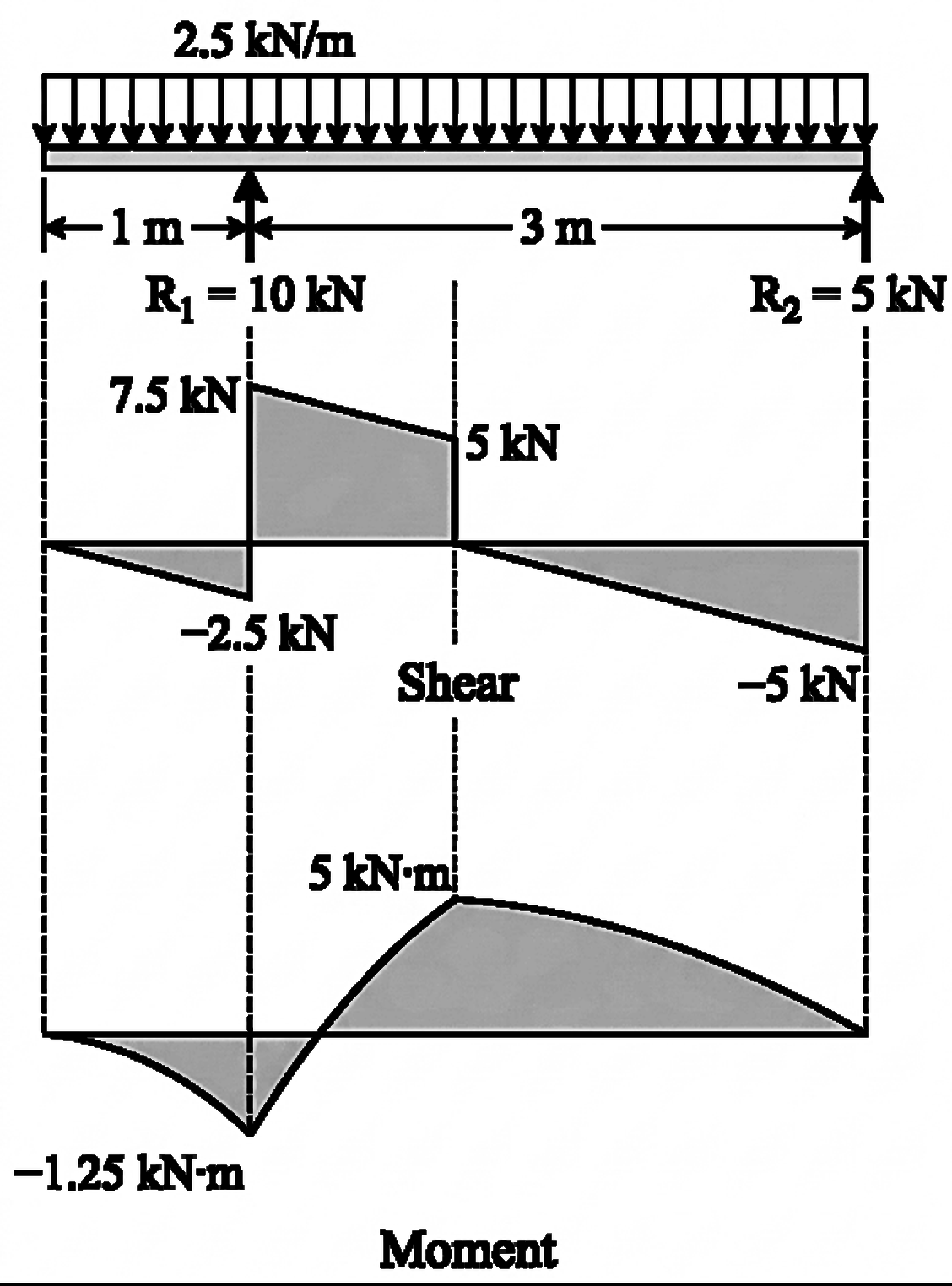
Solution: From the moment diagram, Mmax = 5 kN·m; the section is 80 mm wide.
∴ Minimum height, h = 137 mm (Answer)
10) A numerical problem on the feed rate of a cutting tool.
(Data could not be collected.)
Answer: Feed rate F = f × N (mm/min); cutting speed V = πDN/1000 (m/min); machining time T = L/(fN) (min); material removal rate MRR = πDNfd (mm³/min).
11) A fixed crane of mass 1000 kg is used to lift a 2400 kg crate. It is held in place by a pin at A and a rocker at B. The centre of gravity of the crane is at G. Determine the components of the reactions at A and B.
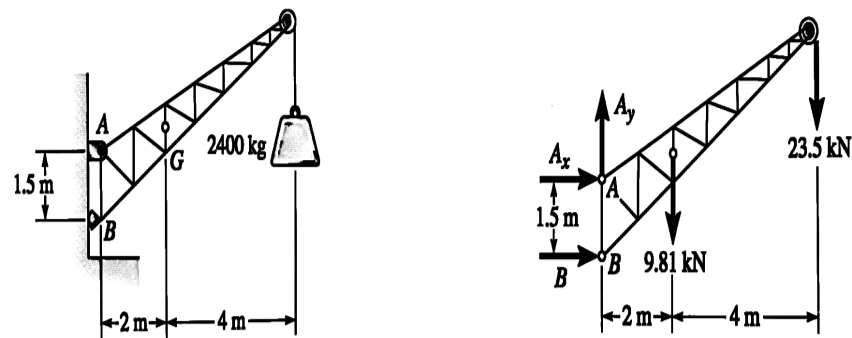
Solution: AB = 1.5 m (vertical), G is 2 m and the crate is 6 m horizontally from A.
∴ B = 107.1 kN →; Ax = 107.1 kN ←; Ay = 33.3 kN ↑ (Answer)
12) Write short notes on: clearance, allowance and tolerance.
Solution: QB-544, Prasangik Technical (BPSC).
Clearance: The difference between the hole size and the shaft size when the hole is larger; it permits relative motion. Clearance = Hole size − Shaft size.
Allowance: The intentional difference between the maximum material limits of mating parts (minimum hole − maximum shaft); it is the minimum clearance (positive allowance) or maximum interference (negative allowance).
Tolerance: The permissible variation in a dimension; Tolerance = Upper limit − Lower limit.
13) Steam in the condenser of a steam power plant is to be condensed at 30°C (hfg = 2431 kJ/kg) with cooling water (cp = 4184 J/kg·°C) from a nearby lake, which enters the tubes at 14°C and leaves at 22°C. The surface area of the tubes is 45 m² and the overall heat transfer coefficient is 2100 W/m²·°C. Determine the mass flow rate of the cooling water and the rate of condensation of the steam.
Solution:
∴ Cooling water = 32.6 kg/s; Rate of condensation = 0.449 kg/s (Answer)
14) Water at 20°C flows steadily into a piping junction at section 1 at 20 gal/min. The average velocity at section 2 is 2.5 m/s. A portion of the flow is diverted through a showerhead having 100 holes of 1 mm diameter. Assuming uniform shower flow, estimate the exit velocity of the shower jets.
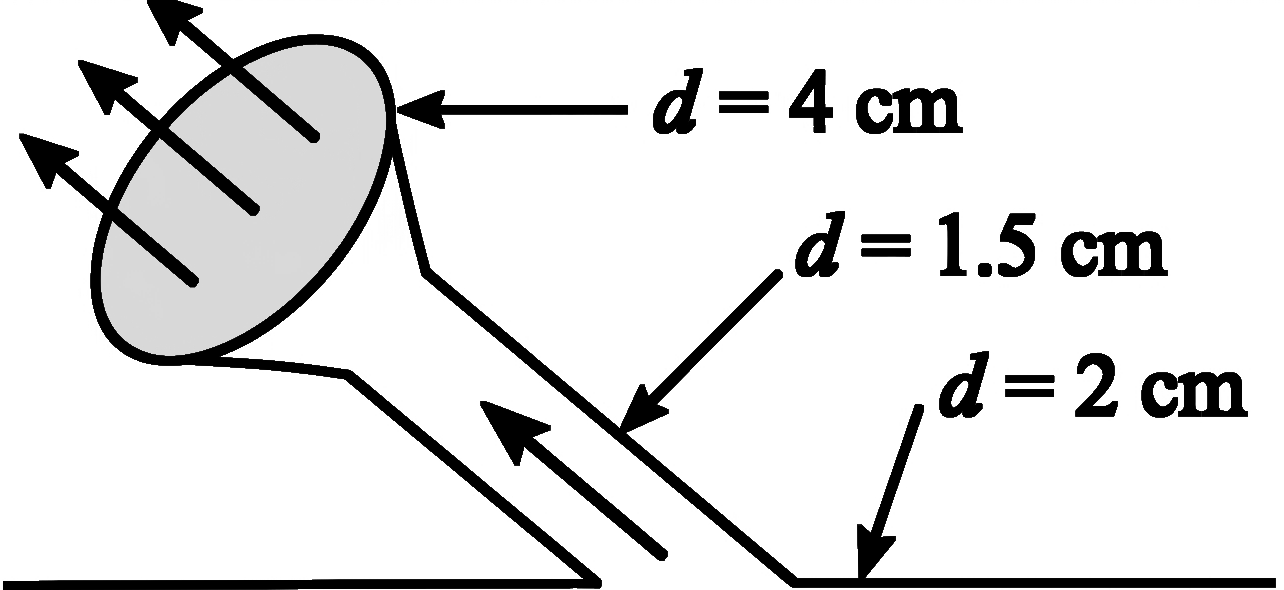
Solution: D2 = 2 cm; 1 gal = 3.785 × 10⁻³ m³.
∴ Jet velocity ≈ 6.1 m/s (Answer)