
Mechanical Engineering Question Bank
Sonali Bank PLC- 2026
Post: Assistant Engineer (Mechanical)
Exam Date: 16.05.2026 Exam Hall: Tejgaon Govt. High School, Dhaka
Time: 2 Hours Total Marks: 200
Departmental (Written):
1) A 5 TR refrigeration plant draws 3.75 kW of electrical power. The refrigerant absorbs 56 kJ/kg during evaporation. Calculate the COP of the plant and the mass flow rate of the refrigerant.
Solution: Q7, QB-197, Dhaka Power Distribution Company Limited (DPDC)-2020.
2) List the mountings and accessories of a boiler. Sketch a schematic diagram of a gas-fired boiler showing the flue gas path and the accessories.
Answer: Q4, QB-241, Karnaphuli Gas Distribution Company Limited (KGDCL)-2021.
3) A pump lifts crude oil of density 0.92 g/cm³ at a rate of 0.055 m³/s to a height of 10 m through a pipe of 220 mm diameter. The overall efficiency is 60% and the friction factor is f = 0.05. Calculate the power required to drive the pump.
Solution: Given, ρ = 920 kg/m³, Q = 0.055 m³/s, z = 10 m, d = 0.22 m, ηo = 0.60, f = 0.05. The pipe length is taken equal to the lift (L = 10 m).
(Answer)
4) A single-stage impulse turbine has a mean wheel diameter of 120 cm and runs at 3000 rpm. If the blade speed ratio is 0.42, find the velocity of steam at the inlet.
Answer: (Answer)
5) Determine the heat transfer coefficient for a 120 mm diameter steel pipe placed horizontally in ambient air at 25°C, if the Nusselt number is 30 and the thermal conductivity of air is 0.05 W/m·K.
Answer: (Answer)
6) Differentiate between winter air conditioning and summer air conditioning, mentioning the processes involved.
Solution:
| S.No. | Winter Air Conditioning | Summer Air Conditioning |
|---|---|---|
| 1. | It keeps the space warm and adds moisture to the air. | It keeps the space cool and removes moisture from the air. |
| 2. | The basic processes are sensible heating and humidification. | The basic processes are cooling and dehumidification. |
| 3. | The air is preheated, humidified and then reheated. | The air is cooled below its dew point for dehumidification and then reheated, if required. |
| 4. | The main equipment are the heating coil and the humidifier. | The main equipment are the cooling coil (refrigeration unit) and the dehumidifier. |
| 5. | On the psychrometric chart, both the dry bulb temperature and the specific humidity increase. | On the psychrometric chart, both the dry bulb temperature and the specific humidity decrease. |
| 6. | The indoor design condition is about 21–23 °C DBT and 40–50% RH. | The indoor design condition is about 24–26 °C DBT and 50–60% RH. |
7) A workpiece of 100 mm diameter is turned at a spindle speed of 800 rpm with a feed of 0.25 mm/rev and a depth of cut of 3 mm. Calculate (i) the cutting speed (m/min) and (ii) the feed rate (mm/min).
Solution:
∴ (i) Cutting speed = 251.3 m/min; (ii) Feed rate = 200 mm/min (Answer)
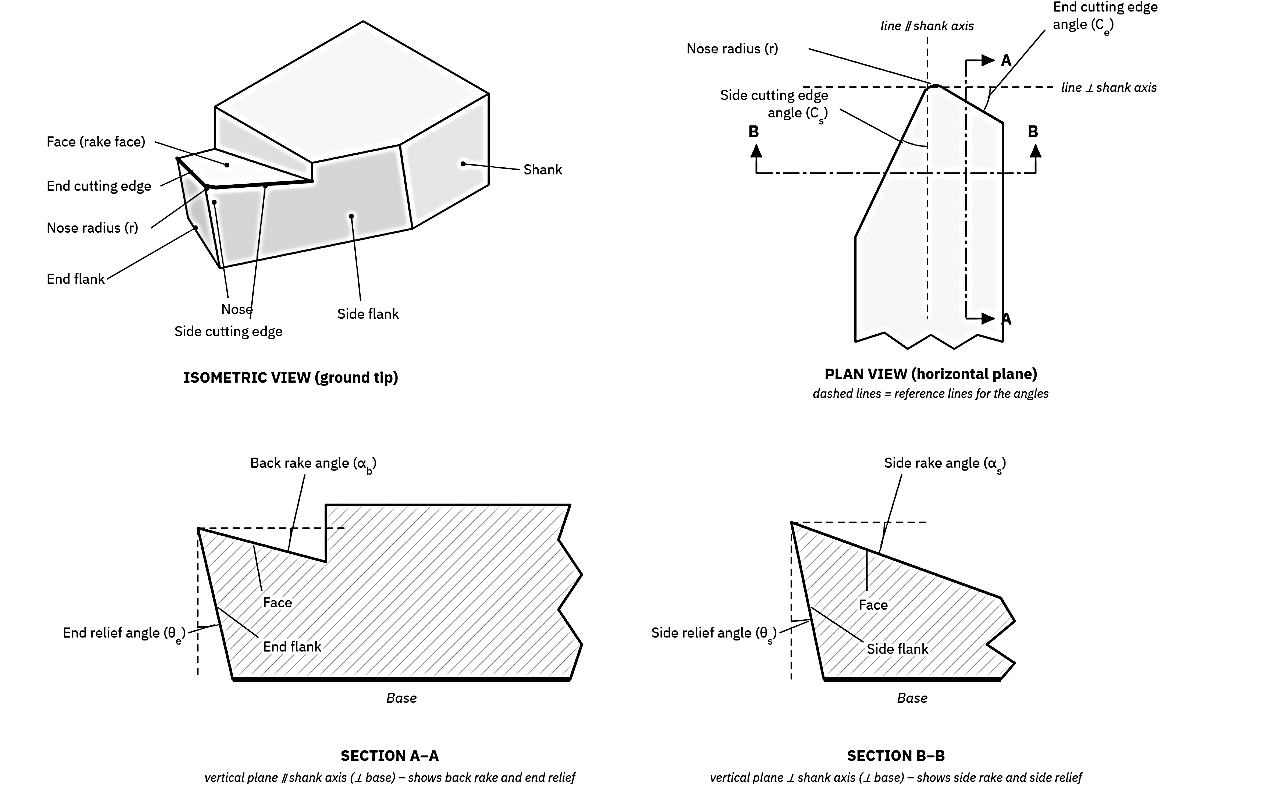
8) Draw a single point cutting tool showing the tool geometry.
Solution:
9) A heavy-duty machine needs a power transmission drive. Would you select a belt drive or a gear drive? Why?
Solution: A gear drive should be selected. A heavy-duty machine transmits high power and torque, often with shock loads, and requires an exact velocity ratio.
| S.No. | Belt Drive | Gear Drive |
|---|---|---|
| 1. | It is a friction (non-positive) drive. | It is a positive drive. |
| 2. | Slip and creep occur, so the velocity ratio is not exact. | There is no slip, so the velocity ratio remains exact. |
| 3. | Its power and torque transmitting capacity is limited. | It can transmit very high power and torque. |
| 4. | Its efficiency is about 90–95%. | Its efficiency is about 97–99%. |
| 5. | It is bulky for the same power. | It is compact for the same power. |
| 6. | It is suitable for a long centre distance. | It is suitable for a short centre distance. |
| 7. | On overload, the belt slips and acts as a safety device. | On overload, a separate clutch or shear pin is required for protection. |
A belt drive is preferred only for light loads, long centre distances or where slip protection against overload is desired.
10) A factory needs a pump for continuous water supply against a high head. Option 1: a centrifugal pump with low cost and easy maintenance. Option 2: a multistage pump with higher efficiency but higher cost. Which pump would you select and why?
Solution: Option 2, the multistage pump, should be selected. A multistage pump has several impellers in series on one shaft; each stage adds head, so
A single-stage pump would need a very large impeller or a very high speed to produce a high head, which reduces efficiency and increases stress and vibration. For continuous operation, the higher efficiency of the multistage pump reduces the energy cost, which soon offsets its higher initial cost.
11) A centrifugal pump vibrates excessively while running. What could be the causes and how would you solve the problem?
Solution:
| Cause | Remedy |
|---|---|
| Cavitation (low NPSH available, blocked suction) | Clean the strainer, reduce suction losses or lift; ensure NPSHa > NPSHr |
| Misalignment of pump and motor shafts | Realign with dial indicator or laser alignment |
| Unbalanced, clogged or damaged impeller | Clean, repair or replace and dynamically balance the impeller |
| Bent shaft | Straighten or replace the shaft |
| Worn bearings or poor lubrication | Replace bearings; use correct lubricant |
| Loose foundation bolts, weak base | Tighten bolts, grout the baseplate |
| Pipe strain from unsupported piping | Support the pipes independently; use flexible joints |
| Operation far from the best efficiency point | Adjust flow by valve or variable speed drive |
| Air entrainment or vortex at suction | Ensure proper submergence; vent the casing; stop air leaks |
| Resonance | Change speed or stiffness; add damping |
12) The efficiency of a boiler suddenly decreases and its fuel consumption increases. What are the possible reasons and the common solutions?
Solution:
| Possible reason | Solution |
|---|---|
| Scale on the water side of the tubes | Proper water treatment and blowdown; descale the tubes |
| Soot and fouling on the gas side | Use soot blowers; clean the tubes |
| Too much excess air (high dry flue gas loss) | Tune air–fuel ratio with a flue gas analyser |
| Too little air (incomplete combustion, CO) | Adjust burner and air supply; check draught |
| High flue gas temperature | Clean surfaces; repair economiser/air preheater |
| Air leakage through casing and ducts | Seal the leaks; repair dampers |
| Faulty burner or controls | Clean and recalibrate |
| Low feed water temperature | Repair economiser/deaerator |
| Excessive blowdown, steam leaks, faulty traps | Optimise blowdown; repair leaks and traps |
| Damaged insulation | Repair insulation and refractory |
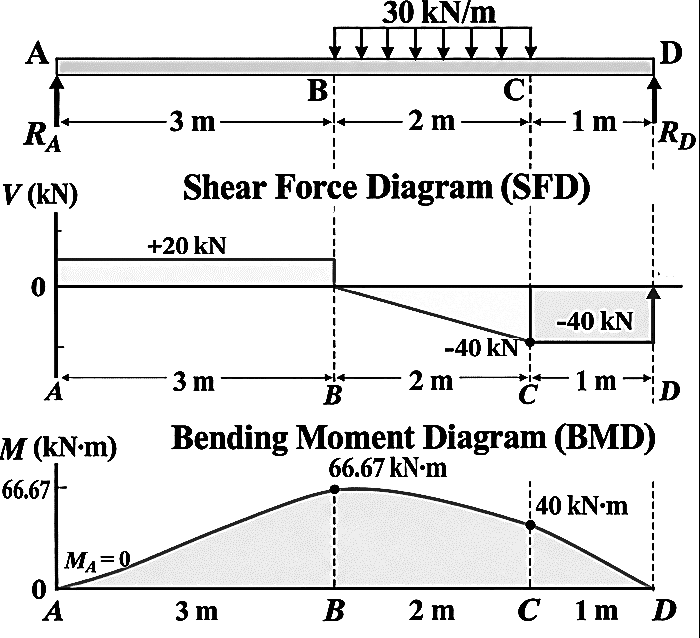
13) Draw the SFD and BMD of the beam loaded as shown.
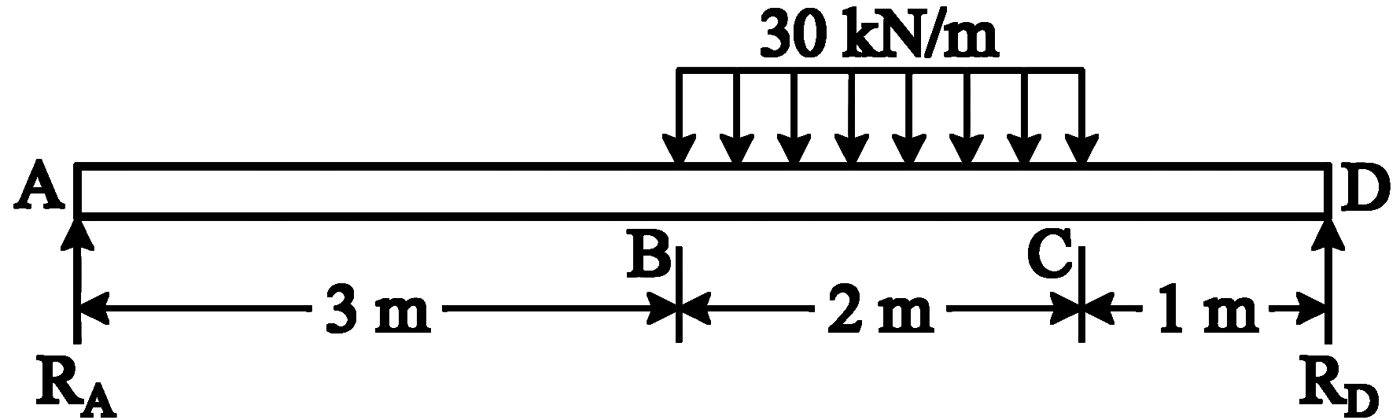
Solution: Span AD = 6 m; UDL w = 30 kN/m over BC (2 m). Total load = 60 kN acting 4 m from A.
Shear force: AB: +20 kN; BC: V = 20 − 30(x − 3), so VC = −40 kN; CD: −40 kN. Zero shear at x = 3 + 20/30 = 3.667 m from A.
Bending moment:
14) Explain the volute casing and the vortex casing of a centrifugal pump.
Solution: Volute casing: A spiral casing surrounding the impeller whose area of flow increases gradually from the tongue to the delivery. The increasing area reduces the velocity of water and converts part of the kinetic energy into pressure energy. Eddies are formed, so its efficiency is somewhat lower.
Vortex casing: A circular chamber (whirlpool chamber) is provided between the impeller and the volute. Water first moves in a free vortex in this chamber, which converts a part of the velocity head into pressure head, and then enters the volute. Eddy losses are reduced and the efficiency is higher than that of the simple volute casing.
15) What is supply chain management (SCM)? Explain its role in improving customer satisfaction.
Solution: Supply chain management is the coordinated planning and control of the flow of materials, products, information and money from the suppliers of raw materials, through manufacturing and distribution, up to the final customer.
Role in customer satisfaction: right product available at the right time (no stock-out); shorter and reliable delivery lead time; lower cost through efficient purchasing, inventory and transport, allowing competitive prices; consistent quality through supplier selection and traceability; and quick response to changes in customer demand through information sharing.
16) Explain the key principles of Statistical Quality Control (SQC) and its contribution to industrial management. Discuss the tools of SQC with practical examples.
Solution: SQC is the use of statistical methods to monitor, control and improve the quality of products and processes.
Principles: every process has variation — chance (common) causes and assignable (special) causes; decisions are based on data from samples, not guesswork; processes are monitored continuously to detect assignable causes early; defects are prevented rather than detected after production.
Contribution: uniform and better quality, less scrap and rework, lower inspection and production cost, higher productivity and customer satisfaction, and a basis for continuous improvement.
Tools with examples:
- Control charts (X̄–R, p, c charts): monitoring the fill volume of bottles in a beverage plant.
- Acceptance sampling: accepting or rejecting a lot of bolts from a supplier by inspecting a sample.
- Pareto chart: finding the few defect types causing most rejections in a garment line.
- Cause-and-effect (fishbone) diagram: analysing the causes of poor surface finish in machining.
- Histogram: studying the variation of package weights.
- Check sheet: recording types of defects on an assembly line.
Departmental MCQ:
17) Thermodynamic work is the product of—
18) The cyclic integral of (δQ − δW) is—
19) For a closed system, the difference between the heat added to the system and the work done by the system is equal to the change in—
20) Which of the following is an intensive property?
21) At constant temperature, the pressure–volume relation of an ideal gas is given by—
22) The velocity of sound in air at 27°C is 330 m/s. Its value at 54°C will be—
Explanation: Since a = √(γRT), a ∝ √T: a2 = 330 × √(327/300) m/s.
23) The function of the pump in a Rankine cycle is to—
Answer: Raise the pressure of the feed water (condensate) to the boiler pressure.
24) In a steam condenser, the partial pressures of steam and air are 0.06 bar and 0.007 bar respectively. The condenser pressure is—
Explanation: By Dalton’s law, p = 0.06 + 0.007 = 0.067 bar.
25) If the number of reheating stages in a gas turbine is increased to infinity, the expansion tends to be—
26) The condenser of a refrigerator rejects heat at 120 kW while the compressor consumes 30 kW. The COP of the refrigerator is—
Explanation: QL = 120 − 30 = 90 kW; COP = 90/30 = 3.
27) The pressure exerted by the vapour of a liquid confined in a closed vessel is called—
28) A higher Reynolds number indicates—
29) The flow in which fluid particles move in parallel layers is—
Answer: Laminar flow.
30) The flow in which the velocity is the same at every section (point) of the flow is called—
Answer: Uniform flow.
31) Prandtl number is the ratio of—
32) A furnace wall of red brick (k = 0.7 W/m·K) is 0.5 m thick. For the same heat loss and temperature drop, it is replaced by diatomite earth (k = 0.14 W/m·K). The required thickness is—
Explanation: L2 = L1 × k2/k1 = 0.5 × 0.14/0.7 = 0.1 m.
33) For the same heat flow and the same thickness, the temperature drop will be maximum across—
34) In a heat exchanger in which one fluid evaporates or condenses, the surface area required is minimum for—
35) A bar has a lateral strain of −60 × 10⁻⁵ under an axial tensile stress of 300 MPa. If Poisson’s ratio is 0.3, the modulus of elasticity is—
Explanation: εaxial = 60 × 10⁻⁵/0.3 = 2 × 10⁻³; E = 300/(2 × 10⁻³) = 150,000 MPa = 150 GPa.
36) A beam is said to be of uniform strength if—
Answer: The bending stress is the same at every section along its length.
37) The distortion energy is associated with—
38) The Coulomb–Mohr theory of failure is suitable for—
39) In a thick-walled cylinder subjected to external pressure only, the maximum hoop stress occurs at the—
Answer: Inner surface.
40) The number of degrees of freedom of the spring–mass system shown is—
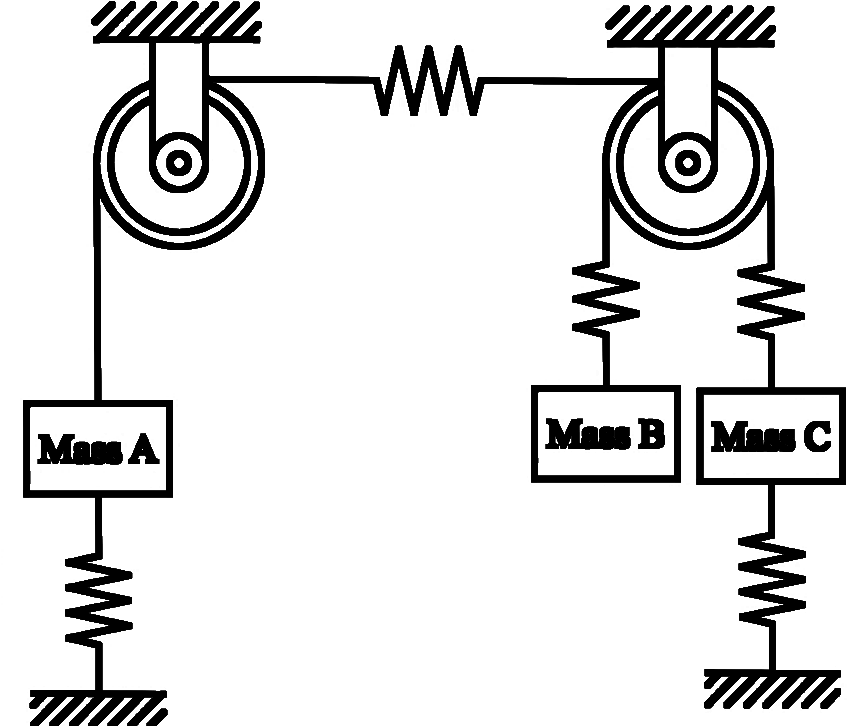
Explanation: The three masses and the rotation of the right pulley are independent; the rotation of the left pulley is fixed by the motion of mass A.
41) The number of instantaneous centres of a four-link mechanism is—
Explanation: N = n(n − 1)/2 = 4 × 3/2 = 6.
42) Two balls of the same size but different weights are dropped from the same height. Neglecting air resistance—
43) A road roller is pulled over an obstacle by a force F. The force F required is minimum when it acts—
Answer: Perpendicular to the line joining the centre of the roller and the point of contact with the obstacle.
44) A complete phase recrystallisation and fine grain structure in castings, forgings and rolled parts is obtained by—
45) In arc welding, the arc length is usually kept approximately equal to—
46) Piston rings are commonly made of—