
Mechanical Engineering Question Bank
North-West Power Generation Company Limited (NWPGCL)- 2026
Post: Assistant Engineer (Mechanical)
Exam Date: 27.06.2026 Exam Hall: DUET
Time: 1 Hour 30 Min Total Marks: 100 (MCQ 30, Written 70)
Exam Taker: DUET
Departmental (Written):
1) For a thermal power plant, the efficiencies of the generator, turbine, boiler, cycle and overall plant are 0.97, 0.95, 0.92, 0.42 and 0.33 respectively. What percentage of the total electricity generated is used for running the auxiliaries? [5 Marks]
Solution:
∴ Electricity used for running the auxiliaries = 7.32% (Answer)
2) What are the performance parameters of a cooling tower? In a cooling tower, the water inlet and outlet temperatures are 36°C and 31°C. The ambient air temperature is 28°C (wet-bulb temperature 26°C). Find the efficiency of the cooling tower. [5 Marks]
Solution: The performance of a cooling tower is expressed by:
Range: Difference between the hot water inlet temperature and the cold water outlet temperature.
Approach: Difference between the cold water outlet temperature and the ambient wet-bulb temperature. A lower approach indicates better performance; it is the better indicator of cooling tower performance.
Effectiveness (efficiency): Ratio of the range to the ideal range (range + approach).
The dry-bulb temperature (28°C) is not required.
∴ Cooling tower efficiency = 50% (Answer)
3) Compare the efficiency of the Rankine cycle and the Carnot cycle working between the same maximum and minimum temperatures. [5 Marks]
Solution:
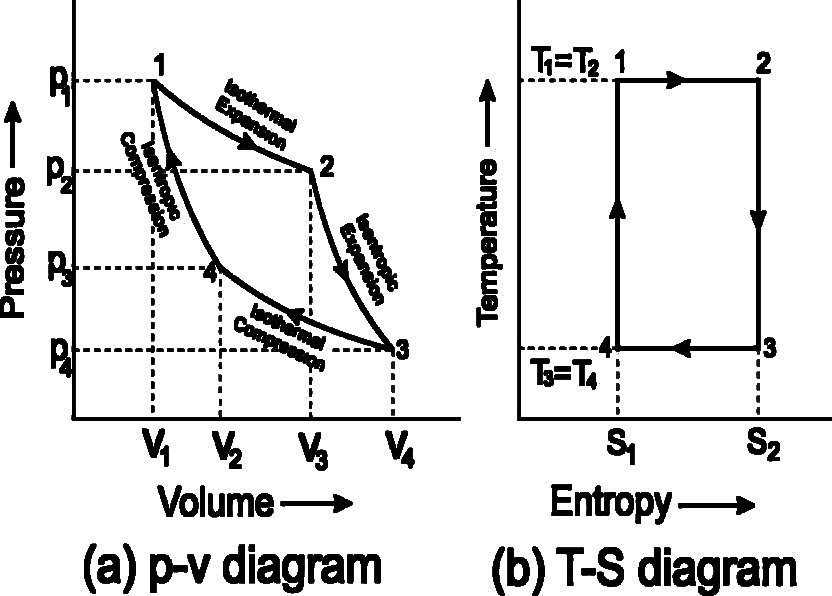
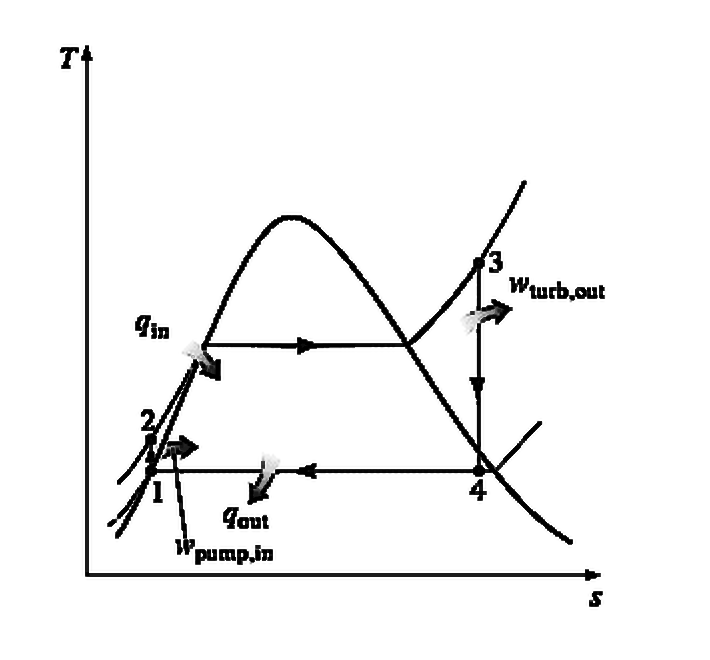
In the Carnot cycle, all the heat is added at the maximum temperature. In the Rankine cycle, a large part of the heat is added while the feed water is heated from the pump outlet temperature to the saturation temperature (and in the superheater), so the mean temperature of heat addition Tm,add is lower than Tmax. Hence, for the same temperature limits,
The Rankine cycle is still used in practice because it avoids compression of a wet mixture and needs only a small pump work.
4) Draw the performance characteristic curves of a centrifugal pump and show the design point and duty point. [5 Marks]
Same as Q4, BPDB-2026 (this Supplement); no separate answer printed here.
Answer: [Repeated question: BPDB-2026] [Repeated question: Q4, BPDB-2026 (this Supplement)]
5) In a refrigeration system, the condenser and evaporator temperatures are 20°C and −20°C respectively. Find the COP. If the compression work is 3.5 kW, find the cooling capacity in TR. [5 Marks]
Solution: Assuming a reversed Carnot cycle, TH = 293 K, TL = 253 K.
(With 1 TR = 3.517 kW, the capacity is 6.30 TR.)
∴ COP = 6.325; Cooling capacity ≈ 6.3 TR (Answer)
6) A plant operates two pumps, each consuming 45 kW and running 6000 hours annually. A high-efficiency pump can perform the same duty while consuming 35 kW. If the energy cost is $0.01 per unit, (i) what will be the energy saving, and (ii) what will be the cost saving if one of the pumps is replaced by the efficient one? [10 Marks]
Solution:
∴ Energy saving = 60,000 kWh/year; Cost saving = $600/year (Answer)
7) How is the heat transfer rate in a heat exchanger determined? What are the factors affecting it? [5 Marks]
Solution: The heat transfer rate is determined by
(i) Energy balance of either fluid:
For a condensing or evaporating fluid, Q̇ = ṁhfg.
(ii) LMTD method:
where F = 1 for parallel or counter flow and F < 1 for multipass or cross flow. (When outlet temperatures are unknown, the ε–NTU method is used.)
Factors affecting the heat transfer rate: overall heat transfer coefficient U (fluid velocity, properties, wall material and thickness); heat transfer area A; temperature difference and flow arrangement (counter flow gives the highest ΔTlm); mass flow rates and specific heats; fouling and scaling; and phase change of the fluids.
8) In a Rankine cycle, the turbine inlet enthalpy is 3200 kJ/kg, the turbine outlet enthalpy is 2200 kJ/kg, the pump work is 10 kJ/kg and the condenser outlet enthalpy is 200 kJ/kg. Find the cycle thermal efficiency. [5 Marks]
Solution: With h1 = 200 kJ/kg (condenser outlet), h3 = 3200 kJ/kg, h4 = 2200 kJ/kg and wp = 10 kJ/kg:
∴ Thermal efficiency = 33.11% (Answer)
9) In the following matrix, the weighting factors of different criteria for three separate pumps are given. Calculate the weighted average and select the best pump. Is the result statistically significant? [10 Marks]
| Criteria | Weighting factor | Pump A | Pump B | Pump C |
|---|---|---|---|---|
| Cost | 0.30 | 9 | 5 | 8 |
| Efficiency | 0.30 | 7 | 9 | 7 |
| Reliability | 0.25 | 8 | 9 | 9 |
| Maintenance | 0.15 | 6 | 7 | 6 |
Solution:
Pump A has the highest weighted score and is selected.
The result cannot be called statistically significant. The matrix is a deterministic decision (weighted scoring) model: single ratings are given without any sample, variance or repeated observations, so no significance test (t-test, ANOVA) can be applied. Moreover, the difference between A and C is only 0.05, so a sensitivity analysis of the weights would be more meaningful.
∴ Best pump = Pump A (score 7.70); statistical significance cannot be established (Answer)
10) A centrifugal pump delivers water at a rate of 150 m³/h against a head of 450 m. The impeller speed is 3000 rpm and the density of water is 1000 kg/m³. If the pump efficiency is 78% and the motor efficiency is 92%, determine the shaft power required by the pump. [5 Marks]
Solution:
(Electrical input to the motor = 235.8/0.92 = 256.3 kW. The speed is not needed.)
∴ Shaft power required = 235.8 kW (Answer)
11) A power plant has a generation capacity of 50 MW and an efficiency of 0.4. If the heating value of coal is 25 kJ/kg, determine the coal consumption per hour. [5 Marks]
Solution: The heating value of coal is evidently 25 MJ/kg (25 kJ/g); this value is used.
∴ Coal consumption = 18,000 kg/h = 18 tonnes/h (Answer)
12) A power station has to supply the following loads. Draw the load duration curve (LDC) and calculate the load factor. [5 Marks]
| Time (hours) | 1–6 | 6–12 | 12–14 | 14–18 | 18–24 |
|---|---|---|---|---|---|
| Load (MW) | 30 | 90 | 60 | 100 | 50 |
Solution: The first interval is taken as 0–6 h so that the schedule covers the full day.
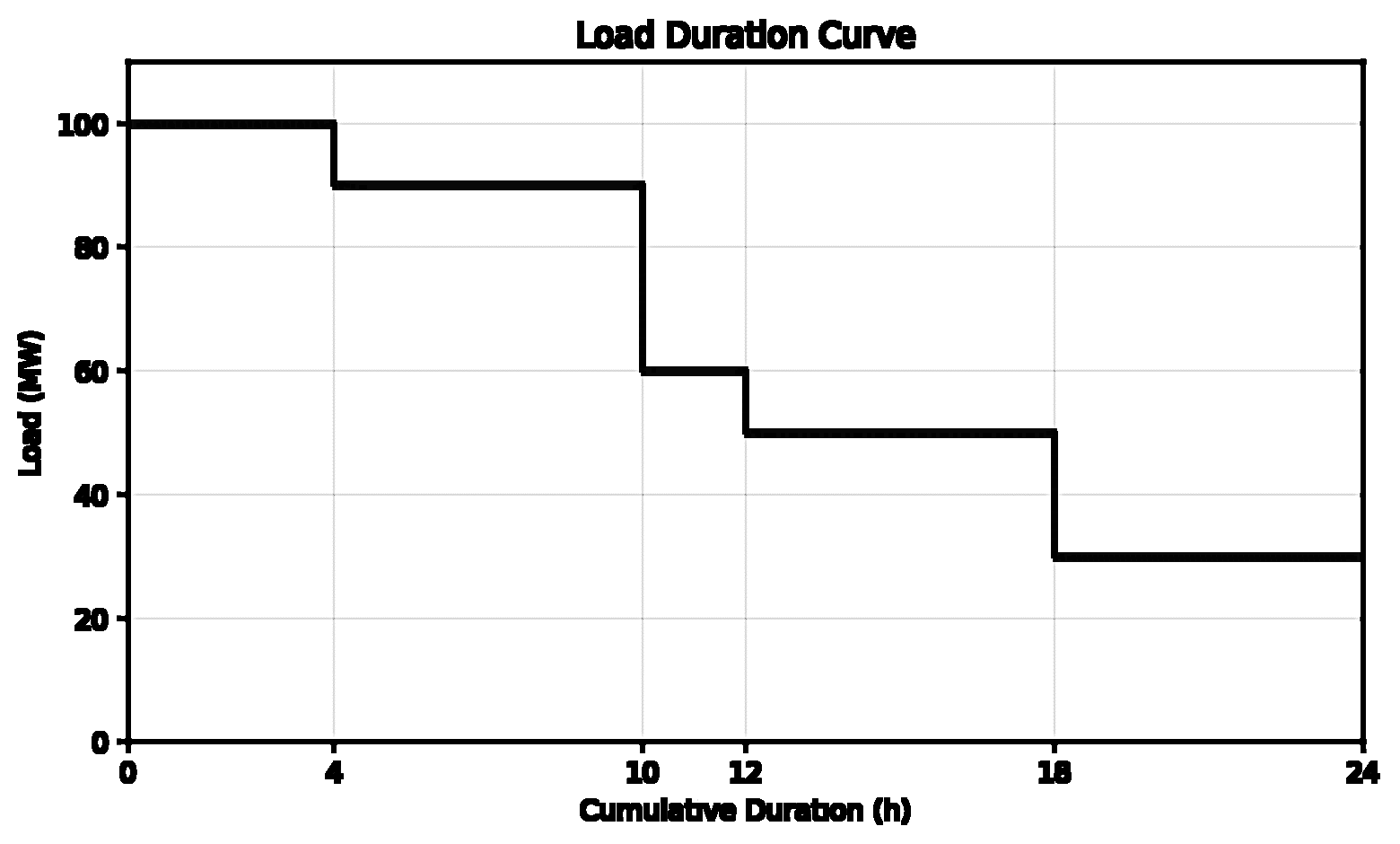
∴ Load factor = 64.2% (Answer)
Non-Departmental MCQ:
13) When does the system frequency fall in a power system?
Answer: When the load demand becomes greater than the generation.
14) A low power factor results in—
Answer: Higher current for the same power (higher losses and voltage drop).
15) Improvement of power factor mainly reduces the—
16) Which fuel is primarily used in the power plants of Bangladesh?
Answer: Natural gas.
17) Which power plant has the lowest generation cost?
Answer: Hydroelectric power plant.
18) Which power plant can be started quickly?
Answer: Gas turbine power plant.
19) Which cycle is used in a steam turbine power plant?
Answer: Rankine cycle.
20) বাংলা একাডেমি কবে প্রতিষ্ঠিত হয়?
উত্তর: ৩ ডিসেম্বর ১৯৫৫।
21) ‘ষোড়শ’-এর সন্ধি বিচ্ছেদ কী?
উত্তর: ষট্ + দশ (নিপাতনে সিদ্ধ)।
22) Meaning of ‘Ubiquitous’.
Answer: Present everywhere; omnipresent.
23) Meaning of ‘Blessing in disguise’.
Answer: Something that seems unfortunate at first but later turns out to be good.
24) বাংলাদেশের প্রথম নারী এভারেস্ট বিজয়ী কে?
উত্তর: নিশাত মজুমদার (২০১২)।
25) Who was the first man to set foot on the Moon?
Answer: Neil Armstrong (1969).
26) Which planet is called the Red Planet?
Answer: Mars.
27) Which is the largest ocean in the world?
Answer: The Pacific Ocean.
28) Which is the longest river in the world?
Answer: The Nile.
29) বাংলাদেশের গভীর সমুদ্রবন্দর কোনটি?
উত্তর: মাতারবাড়ী গভীর সমুদ্রবন্দর (কক্সবাজার)।
30) কাগজ প্রথম কোন দেশে আবিষ্কৃত হয়?
উত্তর: চীন।
31) ২০২৬ ফুটবল বিশ্বকাপের সবচেয়ে বেশি ম্যাচ কোন দেশে অনুষ্ঠিত হয়?
উত্তর: যুক্তরাষ্ট্র।
32) তুরস্কের মুদ্রার নাম কী?
উত্তর: লিরা।
33) মানবদেহে রক্ত পরিশোধন করে কোন অঙ্গ?
উত্তর: বৃক্ক (কিডনি)।
34) সিসমোলজি কী?
উত্তর: ভূমিকম্প এবং পৃথিবীর অভ্যন্তরে ভূকম্পন তরঙ্গের (seismic waves) সঞ্চালন নিয়ে বিজ্ঞানের যে শাখা আলোচনা করে, তাকে সিসমোলজি বলে।