
Mechanical Engineering Question Bank
Bangladesh Inland Water Transport Authority (BIWTA)- 2026
Post: Assistant Engineer (Mechanical)
Exam Date: 07.08.2026 Exam Hall: Nawab Habibullah Model School & College, Uttara
Time: 2 Hours Total Marks: Departmental + Mathematics 120, Non-Departmental 80
Exam Taker: MIST
Departmental:
1) What factors are present during explosion (combustion) in a diesel engine?
Solution: Combustion in a CI engine starts by self-ignition of the injected fuel in hot compressed air. The factors that govern it are:
- High compression temperature and pressure (compression ratio 14–22)
- Fuel injection pressure, injection timing and rate of injection
- Atomisation, penetration and spray pattern of the fuel
- Air–fuel ratio and air motion (swirl/turbulence) in the combustion chamber
- Ignition delay period, which depends on the cetane number of the fuel
- Temperature of the cylinder walls and the intake air (supercharging)
2) Define limit, tolerance and deviation in manufacturing a shaft.
Solution: Limits: The two extreme permissible sizes of a shaft — the upper (maximum) limit and the lower (minimum) limit. Example: a shaft of 50.00/49.95 mm.
Tolerance: The difference between the upper and lower limits of size, i.e. the permissible variation in size. Tolerance = Upper limit − Lower limit = 50.00 − 49.95 = 0.05 mm.
Deviation: The algebraic difference between a size (actual or limit size) and the corresponding basic size. Upper deviation = Upper limit − Basic size; Lower deviation = Lower limit − Basic size.
3) Define COP and ton of refrigeration. If the COP is 1.2 and the electrical energy consumption is 60 kJ/min, find the refrigeration effect and the heat rejected to the environment.
Solution: COP: The ratio of the refrigerating effect (heat removed from the cold space) to the work input, COP = QL/W.
Ton of refrigeration (TR): The rate of heat removal required to freeze one short ton (907 kg) of water at 0°C into ice at 0°C in 24 hours. 1 TR = 211 kJ/min ≈ 3.5 kW.
Given, COP = 1.2, W = 60 kJ/min = 1 kW.
∴ Refrigeration effect = 72 kJ/min (0.341 TR); Heat rejected = 132 kJ/min (Answer)
4) Differentiate between a fuel priming pump and a fuel booster pump. When are they used?
Solution:
| S.No. | Fuel Priming Pump | Fuel Booster Pump |
|---|---|---|
| 1. | It is used to fill the fuel system and to bleed air from the fuel lines and filters. | It supplies fuel continuously at the required pressure to the fuel injection pump. |
| 2. | It is used before starting, after maintenance or filter change, or when the fuel system has run dry. | It is used during the normal running of the engine. |
| 3. | It is usually hand-operated and delivers a small quantity of fuel. | It is driven by the engine or by an electric motor. |
| 4. | It does not work during the normal operation of the engine. | It prevents vapour lock and fuel starvation of the injection pump. |
5) What is fuel contamination and lubricating oil dilution? What are the reasons behind these?
Solution: Fuel contamination: The presence of unwanted substances — water, dirt, dust, rust, sludge or microbial growth — in the fuel.
Reasons: water entering the storage tank (condensation, rain), dirty containers and poor handling, corrosion inside tanks and pipes, and poor or damaged filters.
Oil dilution: Mixing of fuel with the lubricating oil in the crankcase, which reduces the viscosity and lubricating ability of the oil.
Reasons: leaking or dribbling injectors, over-fuelling and poor atomisation, frequent cold starting and long idling, incomplete combustion, and worn piston rings or liners allowing fuel to pass into the crankcase.
6) Draw the SFD and BMD of the beams shown.
(The figure showed a beam carrying a central point load P and a cantilever carrying a point load P at its free end.)
Solution: (a) Beam with a central point load P (span L, supports at both ends):
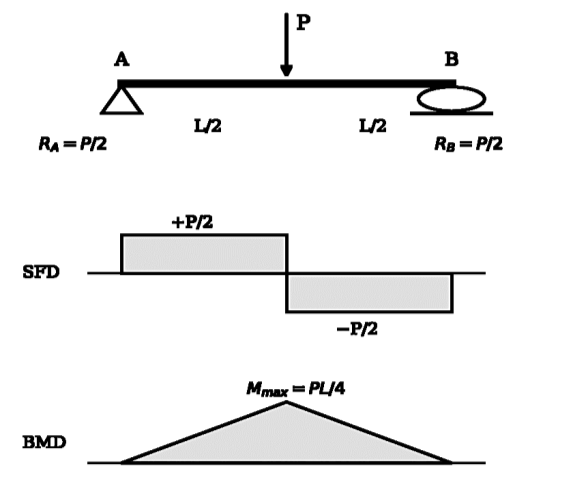
RA = RB = P/2; shear force = +P/2 from A to the load and −P/2 from the load to B; maximum bending moment at the centre, Mmax = PL/4.
If both ends are fixed, the end moments are −PL/8 and the central moment is +PL/8.
(b) Cantilever with a point load P at the free end:
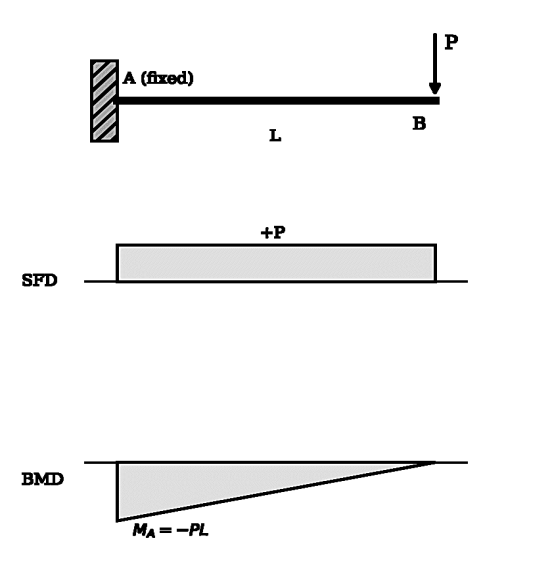
Shear force = P (constant) throughout; bending moment varies linearly from zero at the free end to MA = −PL at the fixed end.
7) A single-acting reciprocating pump has a plunger diameter of 250 mm and a stroke of 300 mm, and runs at 60 rpm. If it delivers 16.5 L/s, find the theoretical discharge, the coefficient of discharge, the slip and the percentage slip.
Solution: Given, D = 0.25 m, L = 0.3 m, N = 60 rpm, Qact = 16.5 L/s.
∴ Qth = 14.73 L/s; Cd = 1.12; Slip = −1.77 L/s (−12.0%) (Answer)
Since the actual discharge exceeds the theoretical discharge, the slip is negative. Negative slip occurs when the delivery valve opens before the end of the suction stroke, as in pumps with long suction pipes and short delivery pipes running at high speed.
8) What is a Stirling engine? Draw its T–s and p–V diagrams.
Solution: A Stirling engine is an external-combustion, closed-cycle regenerative heat engine. A fixed mass of gas (air, helium or hydrogen) is alternately heated and cooled; heat is supplied from an outside source (fuel, solar, biomass or waste heat). The cycle consists of two isothermal and two constant-volume processes, with a regenerator that stores heat during constant-volume cooling and returns it during constant-volume heating. With perfect regeneration its efficiency equals the Carnot efficiency.
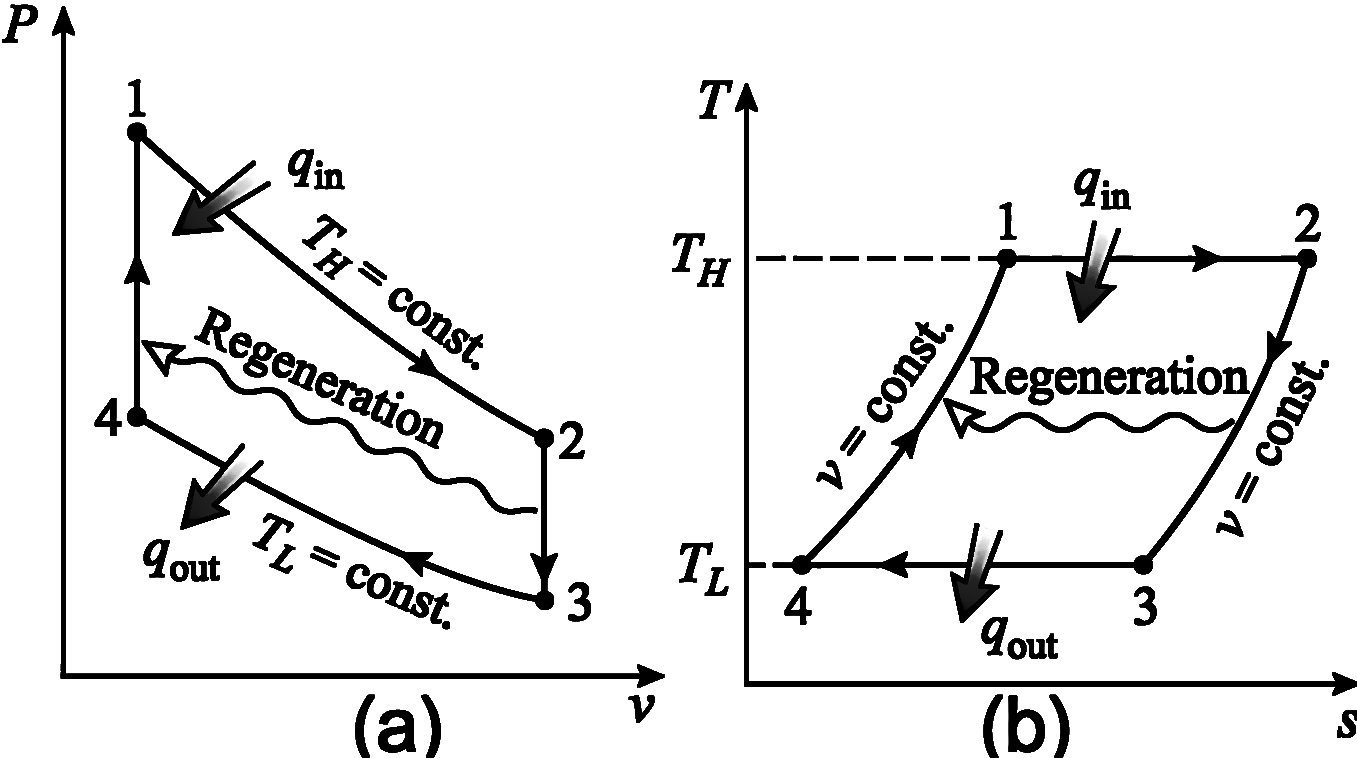
1–2: isothermal compression (heat rejected at TL); 2–3: constant-volume heat addition from the regenerator; 3–4: isothermal expansion (heat supplied at TH); 4–1: constant-volume heat rejection to the regenerator.
9) When does it become mandatory to test a fuel injector?
Solution: An injector must be tested when:
- The engine is hard to start, misfires or runs unevenly.
- There is loss of power or abnormally high fuel consumption.
- Excessive black/white smoke appears in the exhaust or knocking is heard.
- Fuel dribbling, leakage or a poor spray pattern is observed.
- The opening (injection) pressure is suspected to be incorrect.
- After overhauling, repair or replacement of the injector, and at the scheduled maintenance interval.
10) Draw the top, front and side views of the given simple figure.
(Figure could not be collected.)
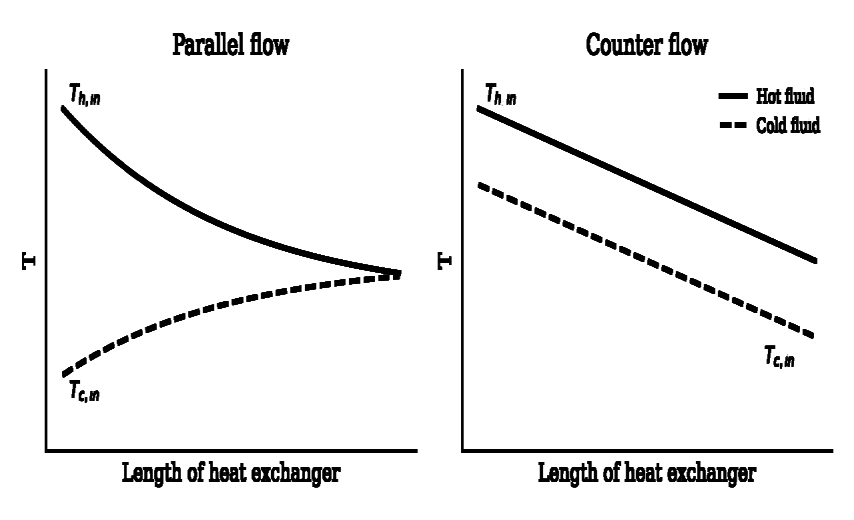
11) Describe parallel, cross and counter flow heat exchangers with figure.
Solution: Parallel flow: Both fluids enter at the same end and flow in the same direction. The temperature difference is large at the inlet and small at the outlet; the cold fluid outlet temperature can never exceed the hot fluid outlet temperature.
Counter flow: The fluids enter at opposite ends and flow in opposite directions. The temperature difference is more uniform along the length, the cold fluid can leave hotter than the hot fluid outlet, and for the same duty it needs the least surface area.
Cross flow: The fluids flow perpendicular to each other, as in automobile radiators and air-cooled condensers. Either fluid may be mixed or unmixed.
12) The bar shown is fixed at A. Portion AB (diameter 30 mm, length 300 mm) and portion BC (diameter 20 mm, length 200 mm) carry loads of 4 kN at B and 3 kN at C. If E of AB is 200 GPa, find the average normal stress in AB and the deformation of AB.
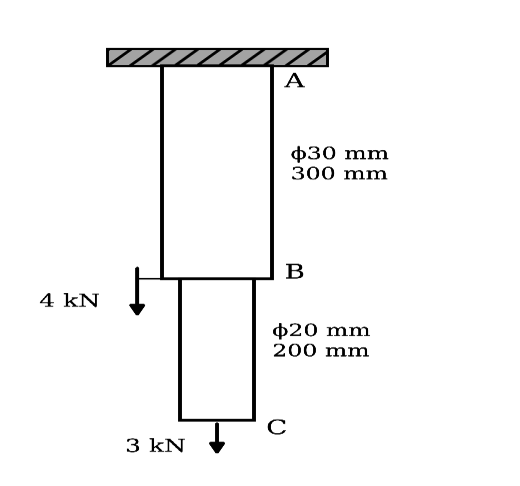
Solution: Axial force in AB = 4 + 3 = 7 kN (tension).
∴ σAB = 9.90 MPa (tensile); δAB = 0.0149 mm (elongation) (Answer)
13) A boiler problem (abnormal condition) was described in the question. What issues can cause the problem?
(Recalled by examinees.)
Solution: Common causes of abnormal boiler operation (low steam output, falling efficiency, pressure drop or overheating) are: scale on the water side and soot on the gas side, low water level or poor circulation, priming and foaming, faulty burner and wrong air–fuel ratio, air leakage into the furnace, leaking or stuck safety valves and steam traps, and faulty feed pump or water level controls.
14) What is priming in a boiler?
Solution: Priming is the carry-over of water particles with the steam leaving the boiler, producing wet steam. It is caused by a very high water level, sudden increase in steam demand, high velocity of steam, and impurities (oil, soap, suspended solids) in the boiler water. It reduces the dryness of steam and can damage turbine blades and engine cylinders. It is prevented by maintaining a proper water level, using steam separators/dry pipes, avoiding sudden steam demand and using clean feed water.
15) What will happen if diesel is poured into a petrol engine?
Solution: Diesel has low volatility and a low self-ignition temperature (low octane number). In a petrol engine it does not vaporise properly in the intake, the spark cannot ignite it reliably and the engine misfires, gives heavy smoke and may stall or fail to start. Unburnt diesel fouls the spark plugs, clogs injectors/filters and dilutes the lubricating oil. The tank and fuel lines must be drained and flushed before restarting.
Mathematics:
16) Given , find Adj(A). Then find A−1.
Solution:
Co-factors:
Check: A·A−1 = I.
17) The curve y = 4 − x² lies between −2 ≤ x ≤ 2. Find the area enclosed by the curve and the x-axis.
Solution:
∴ Area = 32/3 = 10.67 square units (Answer)
18) For y = x⁴ + 2x³ − 3x² − 4x, find the intervals in which y is increasing and decreasing. Also find the maximum and minimum values of y.
Solution:
| Interval | Sign of dy/dx | Behaviour |
|---|---|---|
| x < −2 | − | Decreasing |
| −2 < x < −1/2 | + | Increasing |
| −1/2 < x < 1 | − | Decreasing |
| x > 1 | + | Increasing |
∴ Increasing in (−2, −1/2) and (1, ∞); decreasing in (−∞, −2) and (−1/2, 1). Maximum value = 17/16 at x = −1/2; minimum value = −4 at x = −2 and x = 1 (Answer)
19) Evaluate .
Solution: Put t = tan(x/2), so cos x = (1 − t²)/(1 + t²) and dx = 2dt/(1 + t²).
Non-Departmental:
20) Who is the current President of the UN General Assembly?
Solution: Annalena Baerbock (Germany), President of the 80th session. [Bangladesh’s Foreign Minister Dr. Khalilur Rahman was elected (June 2026) President of the 81st session.]
21) What does SOLAS mean in the maritime sector?
Answer: International Convention for the Safety of Life at Sea.
22) Write the full form of IoT.
Answer: Internet of Things.
23) What is the full form of EEZ and how far does it extend from the coastline?
Answer: Exclusive Economic Zone; up to 200 nautical miles from the baseline.
24) What is the full form of SDG and how many goals are there?
Answer: Sustainable Development Goals; 17 goals (169 targets).
25) স্বাধীন বাংলাদেশে প্রকাশিত প্রথম দৈনিক পত্রিকা কোনটি?
উত্তর: দৈনিক আজাদী (চট্টগ্রাম, ১৭ ডিসেম্বর ১৯৭১)।
26) Which is one of the busiest shipping routes of the world?
27) The Panama Canal connects—
Answer: The Atlantic Ocean (Caribbean Sea) and the Pacific Ocean.
28) Who won the Golden Ball in the FIFA World Cup 2026?
Answer: Rodri (Spain).
29) Bangladesh shares borders with how many Indian states?
Answer: Five — West Bengal, Assam, Meghalaya, Tripura and Mizoram.
30) Which country is known as the “Land of a Thousand Lakes”?
Answer: Finland.
31) Which country recently started a maritime defence alliance?
(as recalled by the examinees)
Answer: Saudi Arabia (as recalled by the examinees).
32) How many members are there in ASEAN?
The rest of the non-departmental part consisted of a paragraph for voice change and right forms of verbs, translation, prepositions and sentence correction.
Answer: 11 (Timor-Leste became the 11th member in October 2025).